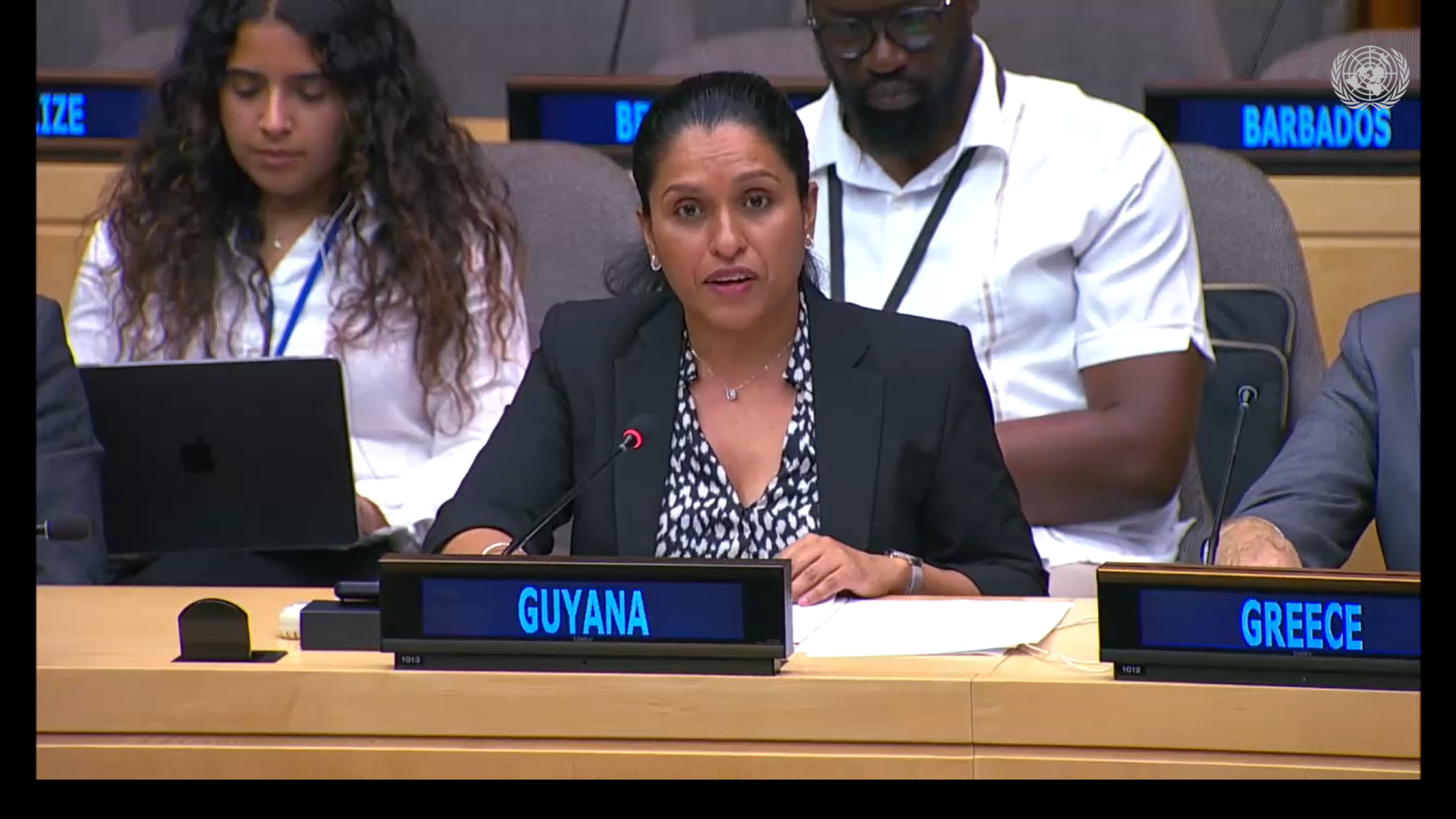
Thank you, Chair,
Guyana is pleased to support Sierra Leone as one of the co-sponsors of today's Arria Formula Meeting on the Global Race for Critical Minerals: Addressing Resource-Driven Insecurity in Africa. I extend appreciation to the briefers for their insightful contributions.
In the past five years, the world has witnessed unprecedented acceleration in the value of trade in unprocessed critical minerals. This has placed resource-rich countries in Africa and elsewhere at the center of a new geopolitical and economic landscape, where they not only have the opportunity to move up the value chain but must confront new challenges owing to porous borders, exploitation by external actors, and weak institutions and security apparatus.
Rising demand for critical minerals and metals, such as lithium, cobalt, and coltan, is driven largely by the demand for clean technology goods to support modern technologies and to achieve the energy transition.
Africa is at the center of this rising demand. According to UNCTAD, Africa holds a significant share of reserves of critical minerals including 55% of global cobalt reserves and 47.65% of global manganese reserves.
The region’s endowment, however, comes with high costs, especially in countries where mineral deposits are concentrated in areas where the State is unable to mobilize or deploy instruments of national power or effectively exercise sovereignty. A consequence of this, according to CTED, is that the exploitation, trade, and trafficking of natural resources - including precious metals and minerals have become significant sources of profit for criminals and are sometimes also used to finance terrorist activities and groups. It has also been a driver of conflicts in Africa.
The UN's recent report on Harnessing the Potential of Critical Minerals for Sustainable Development, underscores how poor governance exacerbates these challenges, thereby creating a cycle of instability and underdevelopment with illicit financial flows siphoning resources from a country and diminishing funds available for public investment and social services.
Chair,
Concerted action is required to address these challenges. We have seen positive results through multi-stakeholder efforts and certification schemes aimed at managing the risks associated with the insecurity in Africa and minerals extraction, such as the Kimberley Process and the Great Lakes Region - Regional Certification Mechanism.
And we heard from our briefers in this regard.
I offer three recommendations on additional actions that can be taken.
First, we need to enhance the enforcement power of the Security Council. As highlighted in the Concept Note, the Council has acknowledged the systematic illicit exploitation and trafficking of natural resources and conflicts. In its resolutions 2195 (2014), 2462 (2019), and 2482 (2019), the Council also drew attention to the use of the proceeds from the illegal exploitation and trafficking of natural resources by armed groups, terrorist groups, and criminal networks supporting them. What is needed now is for the Security Council to adopt a more focused approach to comprehensively address the challenges posed to regional and global peace and security by the illicit exploitation of natural resources.
Second, Security Council’s efforts must be complemented by proactive approaches by relevant governments to embrace good governance practices. Resource wealth does not in itself confer good economic performance. The promotion of transparency and accountability in the mining sector to curb corruption and illicit financial flows will help governments to avoid development pitfalls. The international community should also support reform in the fiscal administration of extractive sectors while encouraging responsible mining practices to safeguard the environment.
Finally, we welcome recent progress towards expanding the Kimberley Process definition of conflict diamonds beyond use to fund rebel groups. The updated definition will allow greater monitoring of infractions by State actors and others involved in the diamond trade. It would also support good governance practices.
I thank you.