Madam President,
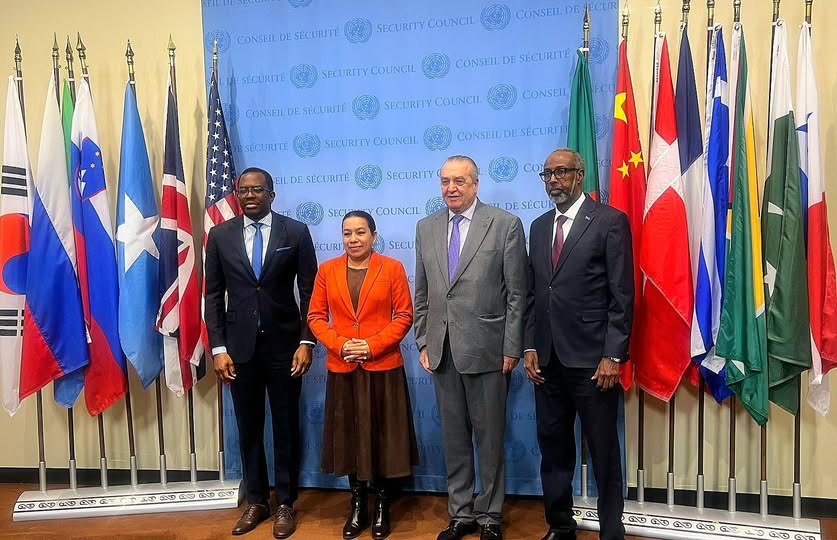
I have the honour to deliver this statement on behalf of the A3+ members: Algeria, Guyana, Somalia, and my own country, Sierra Leone.
We thank Special Representative of the Secretary-General (SRSG) Bintou Keita for her informative and comprehensive briefing on the situation in eastern Democratic Republic of Congo (DRC), and we acknowledge the report of the SecretaryGeneral.
We welcome the participation of the DRC in today’s meeting and warmly congratulate our sisterly country on its election as a non-permanent member of this Council for the 2026–2027 term. We also welcome the participation of Rwanda in this meeting.
Madam President,
We are meeting at a very critical moment for the conflict in eastern DRC. The Secretary-General’s report underscores the evolving security, political, and humanitarian challenges facing the country. At the same time, we acknowledge the significant efforts being made to stabilize the situation on the ground.
Since the Security Council last met to consider the situation in eastern DRC, there have been notable developments towards peace and stability. In this context, allow me to highlight the following five points:
First, we express our strong support for, and solidarity with, the brave men and women serving with MUNOSCO, under the UN flag, in an extremely challenging operational environment. We urge this Council, and all regional and international partners, to ensure that MONUSCO personnel are fully supported and empowered to carry out the mandate entrusted to them by this Council.
In this regard, we welcome SRSG Keita’s leadership and her recent visit to Goma and her direct engagement with MONUSCO personnel. Continued support to MONUSCO is essential for effective mandate implementation. We commend her proactive engagement with the leadership of M23/AFC during that visit. Dialogue with relevant parties remains a critical pathway to peace.
We also commend the role of the International Committee of the Red Cross (ICRC) in facilitating dialogue between MONUSCO and M23/AFC, as part of broader efforts to alleviate the humanitarian situation. We welcome the safe departure of over 1,500 FARDC and PNC personnel from Goma, which the efforts of the ICRC helped to facilitate.
Second, the A3+ welcomes and commends the constructive role of the United States in bringing together the DRC and Rwanda for the signing of a peace agreement. We equally express appreciation to the State of Qatar for its facilitation of dialogue, including between the two leaders.
We acknowledge and commend the efforts of His Excellency Faure Gnassingbé, President of Togo, in his capacity as the African Union-appointed Mediator for the DRC–Rwanda engagement, supported by the panel of five former African presidents who are serving as peace facilitators. We further recognize the valuable contributions of other countries supporting a peaceful resolution to the conflict in eastern DRC.
We are hopeful that the signing of today’s peace agreement will inject renewed momentum into the pursuit of peace and stability in the region. We urge both the DRC and Rwanda governments to remain steadfast in their commitments and to build on this progress.
Third, the A3+ is encouraged by emerging momentum towards an inter-Congolese dialogue aimed at addressing the root causes of the conflict. However, we remain concerned by the continued shrinking of political space, which risks undermining efforts to build national cohesion and trust among political actors. We call for inclusive and positive engagement with all stakeholders in the DRC. In this regard, we acknowledge the important role of the National Episcopal Conference of Congo (CENCO) in fostering national dialogue.
Fourth, we note the recent visit of the Chief of Defence Staff of the Ugandan Military, and his engagement with his Congolese counterpart to advance their joint operations against the Allied Democratic Forces (ADF). While M23/AFC often dominates focus, the ADF, with its links to a global terrorist network, continues to inflict violence and suffering on civilians in Ituri and North Kivu. Continued collaboration between Uganda and the DRC remains critical to addressing this threat.
Fifth and finally, we reiterate our deep concern about the worsening humanitarian situation in the DRC. Ongoing violence by armed groups has left over 10 million people facing acute food insecurity, while humanitarian actors encounter severe access constraints. We appeal to the international community to urgently support the Humanitarian Response Plan, which remains critically underfunded.
The A3+ reminds all parties that international humanitarian law imposes clear obligations to protect civilians during armed conflict. We urge all actors to fully respect international humanitarian and human rights law. In particular, we call on M23/AFC to allow unimpeded access for MONUSCO and humanitarian organizations. We further call on the international community to scale up its support to humanitarian operations in the DRC.
In conclusion, Madam President, following the signing of today’s peace agreement between the DRC and Rwanda, the A3+ urges all parties to uphold their commitments and continue on the path toward durable peace and security in the DRC.
We reaffirm our full solidarity with the people of the DRC and their inalienable right to live in peace within their own country. We further reiterate our call for the full respect of the sovereignty, territorial integrity, and independence of the DRC and all States in the region.
I thank you.