Thank you, Mr. President,
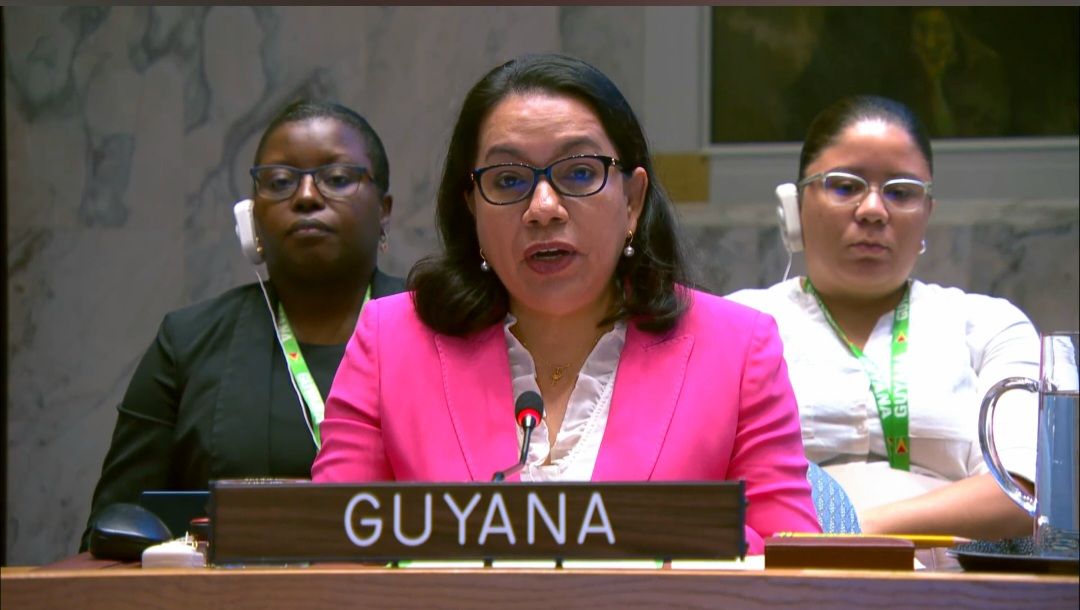
I deliver this statement on behalf of the A3+, namely Algeria, Sierra Leone, Somalia, and my own country, Guyana.
We congratulate Pakistan on its assumption of the presidency of the Security Council and extend our best wishes to you for a successful presidency.
We thank ASG Jenča and Ms. Waly for their briefings and welcome the participation of the representatives of Haiti, the Dominican Republic, Kenya and Barbados - on behalf of CARICOM, in today’s meeting.
We also express our appreciation to Ms. Maria Isabel Salvador for her dedicated service as Special Representative of the Secretary-General for Haiti and Head of BINUH, and look forward to working with her successor. We also reiterate our full support for BINUH and the renewal of the mission’s mandate.
Mr. President,
Each time this Council meets to discuss the situation in Haiti, we are briefed on the deteriorating situation in that sisterly country. Today, we hear once again about the worsening security and humanitarian situation. But what is even more concerning is the fact that the international response continues to be tepid at best and falls short in matching the severity and urgency of the crisis.
We remain gravely concerned by the deepening insecurity in Haiti, particularly in Port-au-Prince, where gangs continue to exert control over significant territory, undermining the rule of law and obstructing the delivery of humanitarian assistance. The limited access to health care and food is further exacerbating the suffering of the Haitian population.
While we sincerely acknowledge the support provided thus far by BINUH, UN agencies, and international, regional, and bilateral partners, including the OAS resolution recently adopted, we appeal for more decisive and coordinated efforts from the international community. At this critical moment, Haiti cannot be left behind.
Amid capacity constraints and a slow response from the international community, frustration and unrest are growing in Haiti. This threatens to undo the political progress achieved since the signing of the 3rd April Political Accord last year. The frustration is also reflected in the rise of vigilante and self-defense groups, which are now pervasive and undermining the government’s authority.
It is, therefore, clear that unless immediate and robust measures are taken to address the prevailing insecurity, the fragile progress achieved thus far and the work of the MSS risk being reversed.
The A3+ commends the ongoing efforts to enhance weapons and ammunition management and to train and strengthen the capacities of the security forces and border control authorities. But we must do more - in the first instance - to stop the illicit flow of arms and ammunition into Haiti. We underscore the need to enhance and ensure the full implementation and enforcement of the arms embargo and other sanctions measures imposed by the Security Council, and remain prepared to expand the sanctions list.
Mr. President, Colleagues,
Last week marked one year since the first batch of MSS personnel arrived in Haiti. At the time, this elicited both a sense of hope and optimism among the Haitian population and within the international community. While not a UN mission, the deployment of the MSS represented a milestone for multilateralism and a firm demonstration of international solidarity.
The A3+ pays tribute to Kenya for its leadership and commends all who have contributed financing, training, personnel, and equipment to the mission. Additionally, we call on those who have pledged to provide support and funding to the MSS to honour their commitments.
We note that the mission is unable to effectively carry out its mandate, as envisioned in resolution 2699, owing to a shortfall in voluntary funding. Even while operating below 40% of capacity, the mission has been able to assist the HNP in regaining control over critical infrastructure, recapturing neighbourhoods, and facilitating the reopening of schools and the delivery of humanitarian aid. But the MSS would not be able to achieve its mandate when it is operating at less than 40% of its strength. This Council has requested and received options presented by the Secretary-General more than four months ago regarding the future of the MSS mission in Haiti.
The A3+ stresses, again, the need for the Security Council to address this matter with urgency and enable the mission with UN operational and logistical support to ensure its full deployment and for it to deliver on its objectives.
Mr. President,
Even amidst the immense challenges which Haiti continues to endure, the A3+ has taken positive note of the progress made in advancing the political process. We commend the continued functioning of the transition government and institutions, even in the face of death threats and attacks by armed gangs. We have also noted the adoption of the 2025 Referendum Decree last week and hope that these efforts will be sustained through collective action and enhanced engagement by the relevant stakeholders.
Moreover, we welcome the establishment of specialized judicial units to investigate, prosecute, and adjudicate mass crimes, including cases of sexual violence, and commend the support provided by BINUH, OHCHR, and UNODC for their operationalization. We emphasize the need to scale up community violence reduction efforts and urge the Haitian authorities to identify a national agency to carry forward the work of the National Commission on Disarmament, Dismantlement, and Reintegration.
Mr. President, Colleagues,
On the humanitarian front, we note that needs continue to outstrip resources, with soaring displacement, deportations, food insecurity, sexual and gender-based violence, recruitment of children, and a collapse of essential services leaving millions vulnerable.
Haiti is also facing its worst levels of food insecurity since the 2010 earthquake, with 5.7 million people — half the population — currently experiencing acute food insecurity.
At just 8.2% funded, the 2025 Humanitarian Needs and Response Plan is grossly underfunded and impedes the delivery of humanitarian aid. We urge the international community to increase its contributions.
The A3+ also deplores the abhorrent sexual violence that continues to be committed by gangs. In just a period of two months
- March to April - BINUH has documented 364 incidents involving 378 survivors, including 348 women, 28 girls, and 2 boys. Collective rape was the most common violation with an increase of 76 percent. Indeed, over 2,600 cases of sexual violence were recorded by humanitarian partners from January to April.
As I conclude, Mr. President, colleagues, Algeria, Sierra Leone, Somalia and Guyana do not believe the challenges in Haiti are intractable. In fact, the resilience, strength, and pioneering role of the Haitian people, not only for themselves, but for many others, are well documented. Haiti deserves our support now. It is time to match the expressions of concern with concrete commitments and action. The A3+, therefore, calls upon the international community to adopt a more solution-oriented approach in supporting Haiti to bolster the humanitarian response, strengthen national institutions and address the root causes of instability in the country.
Thank you