

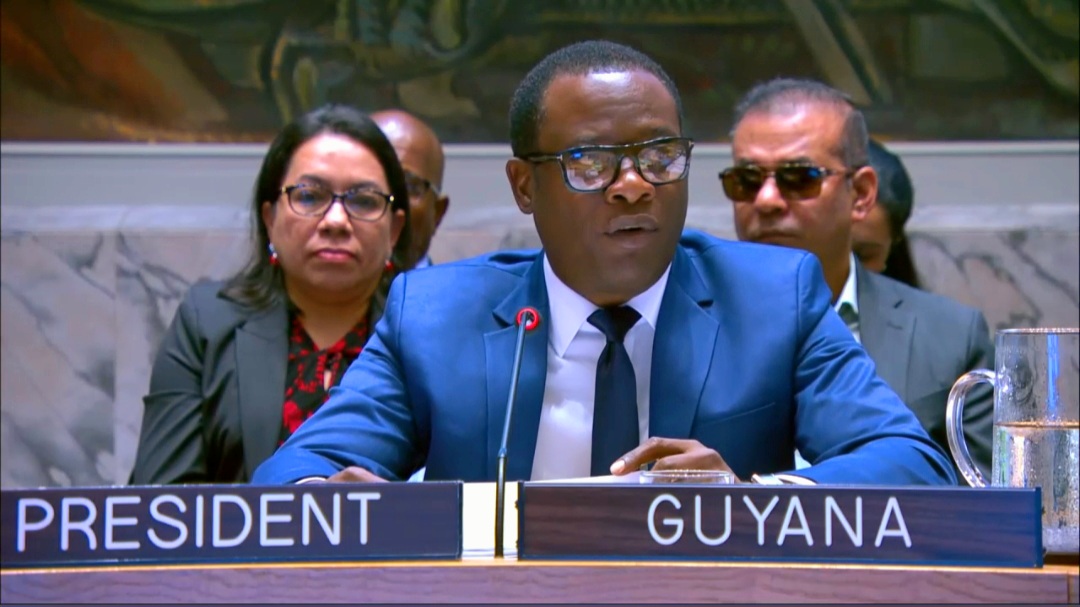
Excellencies,
We meet today amidst immense challenges to international peace and security. This is manifested in the unprecedented number of conflicts and growing tensions in many parts of the world where peace is becoming increasingly fragile.
As challenges to international peace and security evolve, so too must our approach to resolving and preventing conflict. This requires us to delve deeper, including by addressing the root causes of conflict.
For this reason, Guyana has chosen to focus today’s debate on “Poverty, Underdevelopment, and its implications for the maintenance of international peace and security.”
I thank the Secretary-General Antonio Guterres for the insightful perspectives offered on this important topic. I also thank Assistant Secretary-General Ms. Kanni Wignaraja of the UNDP and His Excellency Mahmoud Ali Youssouf, Chairperson of the African Union Commission for their contributions.
Excellencies,
Peace and security cannot be divorced from development. Poverty and underdevelopment are common features across many of the situations of which the Security Council is seized. As a matter of course, the Council must also apply a development lens in carrying out its mandate.
This has been acknowledged by the Council on several occasions. For example, in January 1992, in a Presidential Statement at the first meeting of the Security Council held at the level of Heads of State and Government, the Council affirmed that "peace and prosperity are indivisible, and lasting peace and stability will require effective international cooperation for the eradication of poverty and the promotion of a better life for all in larger freedom." This remains relevant today. Perhaps even more so when global development challenges are deepening.
We should all be concerned that 83% of the targets of the Sustainable Development Goals will not be met by 2030. This is borne out in UNDP's recent Multidimensional Poverty Index which highlighted that 1.1 billion people still live in multidimensional poverty, with almost half a billion residing in countries affected by violent conflict.
Moreover, the 2025 World Social Report warned that an escalation of ongoing conflicts or the emergence of new conflicts would lead to further setbacks in the global effort to eradicate poverty and address underdevelopment.
The world therefore stands at a critical juncture where the interlinkages between peace, security and development have never been more pronounced. This requires collective and decisive action. In this context, I proffer the following points for consideration.
Prioritizing only political solutions in conflicts where poverty and underdevelopment feature prominently will not lead to a comprehensive and sustainable peace. It is equally critical to create conditions for socio-economic stability and wellbeing. We must therefore address, inter alia, lack of economic opportunities, lack of access to education, unemployment and exclusion.
It is also important to strengthen national institutions as part of peacebuilding efforts, including those institutions that foster social and economic development.
Our global institutions must support these efforts. We have been speaking for decades about the need for reform of international financial institutions. We must also see this reform as important for peace and security. In fact, there is truth in the saying that being poor is expensive since developing countries expend more to access finance. The global financial architecture should be more responsive to the needs of developing countries as a whole, particularly countries transitioning out of conflict. This is critical for derisking and resilience building.
I underscore, for example, the IMF’s conclusion that every $1 spent on conflict prevention in countries with recent violence, could save up to $103 in costs. Sound macroeconomic policies and international support for these policies can play key roles in conflict prevention. This should be an element in the Council’s early recovery efforts.
This brings me to my next point – participation of women and youth as part of a broader approach to peace and security. Currently, the global youth population is the highest in history, with most young people concentrated in developing countries. For us to harness their full potential, they must be given adequate economic opportunities and be involved in decision making on peace and security.
This is also a deterrent to recruitment and radicalization by terrorists and armed groups. It is instructive that a 2023 UNDP Report found that economic motivation was the number one reason for young people joining and leaving extremist groups. Ideology was less of a factor.
I also underscore that concerted and determined action that addresses the root causes of conflicts requires a comprehensive approach to women’s involvement in peace and security issues, as this Council has long recognised.
Excellencies,
As the UN observes the eightieth year of its establishment, we must reaffirm equally the three pillars on which the organization is built and the interconnection between those pillars.
In the ongoing engagements on reform of the UN in the context of the UN80 observance, we should ensure that any recalibration does not result in reducing the UN’s role in global development, peace and security, and human rights. Greater coordination and complementarity within the UN system on these issues is critical.
The Security Council cannot operate in silos.
I thank you.